📢 New Release Announcement
We are excited to announce that a new release of PolyDiM is available!
Thank you for your continued support, and we hope you will enjoy working with the new release!



Download the C++ library

Download the Python library
Download the MATLAB library from MathWorks File Exchange
MATLAB is a registered trademark of The MathWorks, Inc. This project is not affiliated with nor endorsed by MathWorks.
PolyDiM is an open-source library based on collaborative development. It provides a flexible framework for solving linear and nonlinear partial differential equations using various numerical methods, including virtual and finite element methods. Designed to work in arbitrary dimensions, it also enables the coupling of 1D, 2D, and 3D problems.
PolyDiM is a submodule of a more advanced library with a rich History, that also includes the submodule
🔭 Read the PolyDiM paper to discover all its functionalities.
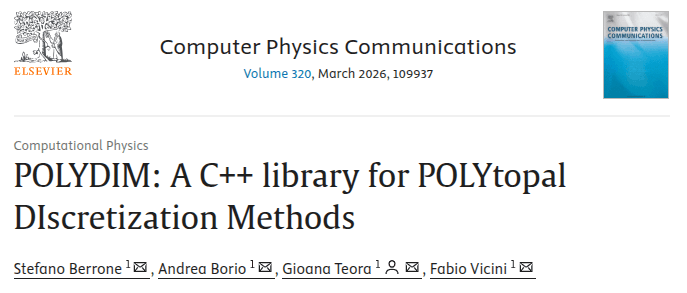
Thank you for your continued support, and we hope you will enjoy reading the paper!
Our team is always enthusiastic to hear ideas and suggestions for new features. If you have an improvement in mind, feel free to reach out via mail.
If you're proposing a major feature or a semantic change, please don’t jump straight into coding. If the idea isn’t a conceptual fit, you might end up wasting valuable time. Instead, start by posting on our mailing list and creating a GitHub issue. Clearly describe what you want to achieve and why.
For minor fixes or enhancements, feel free to open an issue directly on GitHub.
We look forward to collaborating with you!
Andrea, Gioana and Fabio


